Chapter I Independent guide
What is Western esotericism? The mystery tradition, explained
The phrase sounds like one ancient institution. It is closer to a long conversation across two thousand years, carried by books, small groups and a shared set of symbols.
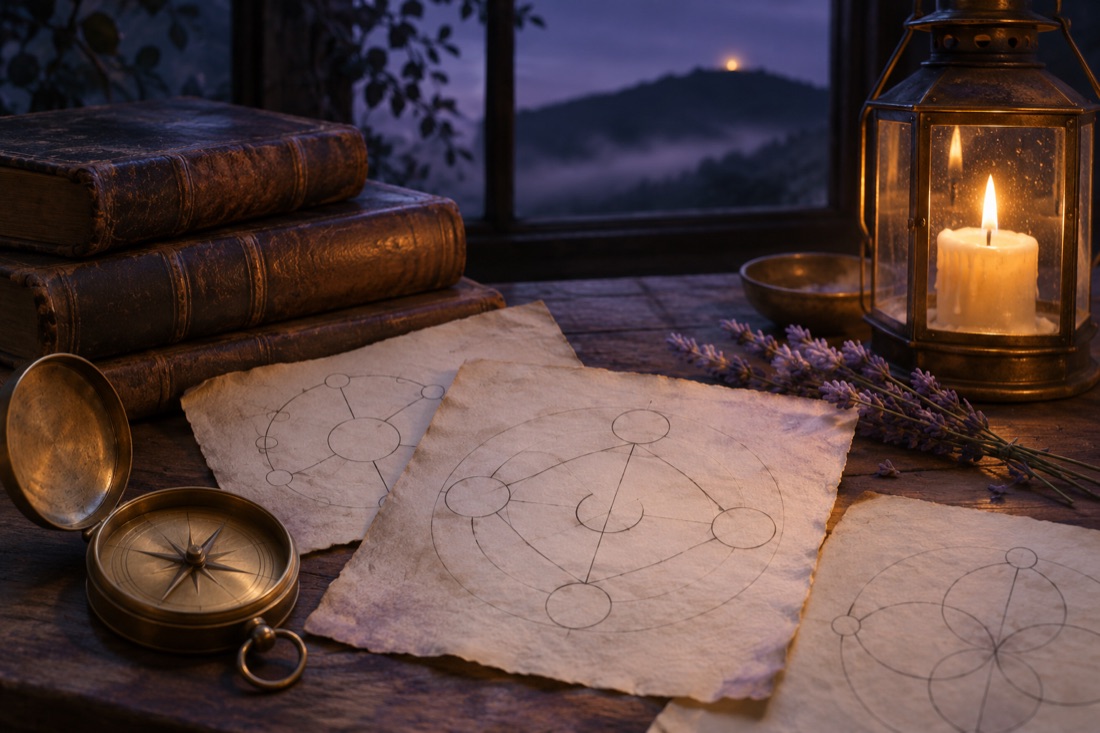
What is Western esotericism: many strands, not one organisation
The Western mystery tradition is a modern label for a family of European currents of thought that treat the universe as meaningful, layered and open to inner work. It draws on Hermetic writings from late antiquity, Neoplatonic philosophy, alchemy, astrology, Christian and later Hermetic readings of Kabbalah, and the ceremonial symbolism of fraternal and ritual groups. A family tree is a useful picture: Hermetic and Neoplatonic writings form the trunk, while Kabbalah, alchemy, astrology and ritual orders are branches that grew at different times.
No single church, school or lineage owns the term. Writers who use it usually mean a body of ideas that was handed on through texts and small circles, often at the edges of official religion and science. Academics who study the same material tend to prefer the phrase Western esotericism, which treats it as a field of history rather than a path to follow.
Types of esoteric knowledge: the ideas that keep returning
Several themes appear again and again. One is correspondence: the belief that the small world of a person mirrors the large world of the cosmos, so that planets, metals, colours and states of mind can be arranged in parallel tables. Another is imagination as a serious tool, used in guided visualisation and symbolic ritual. A third is initiation, the idea that understanding comes in stages and that each stage changes the person who reaches it.
The best known diagram is the Tree of Life from Kabbalistic tradition, ten spheres joined by twenty two paths. Hermetic writers from the Renaissance onward used it as a map for sorting symbols, and nineteenth and twentieth century ritual orders turned it into a teaching scheme. Reading it as a filing system for ideas, rather than as a claim about physics, is the most useful way for a newcomer to approach it.
Where the story begins
The Hermetic texts that inspired so much later writing were composed in Greek in Roman Egypt, in the first centuries of the Common Era. In 1463 the Florentine scholar Marsilio Ficino was asked to translate them into Latin, and they entered the thinking of Renaissance Europe. Alchemy and astrology, much older, flowed into the same stream.
The modern ritual form took shape in Britain and France in the nineteenth century. In London in 1888 the Hermetic Order of the Golden Dawn organised grades, symbols and rituals into one system, and many later groups either descend from it or react against it. In the twentieth century authors such as Dion Fortune, who lived from 1890 to 1946, wrote about the Qabalah and the mind in the language of early psychology, which brought the material to a wider reading public.
Western and Eastern esotericism
Scholars use the word esotericism for a set of currents in Europe and the Mediterranean world, and the label Western marks that geography rather than a doctrine. Mystical and alchemical traditions in Asia are studied separately, and the two are not one system. Where Western writers borrowed from Asian religions, as the Theosophical Society did from 1875, historians trace it as a specific episode, not as proof of a shared origin.
Are there still mystery schools
The phrase mystery school first points to ancient cults such as the Eleusinian Mysteries in Greece. Today many modern groups and courses use the label for teaching programmes of their own. Historians do not treat them as continuous with the ancient cults, and this site does not recommend, rate or speak for any of them.
What historians dispute
Many groups have claimed an unbroken chain reaching back to Egypt, Atlantis or the ancient mysteries of Greece. Historians do not accept these chains. The Hermetic texts were dated to the early Christian centuries by Isaac Casaubon in 1614, and most ritual orders can be traced to documents and founders within the last two to three centuries. That makes the tradition no less interesting as a history of ideas, but it does mean that claims of secret ancient lineage deserve caution.
It is also worth separating the history from the practice. This site describes what people believed and did, without recommending any path, and it does not speak for any order.
Where to go next
If you prefer dates, read the short timeline in the following guide. If you want to see where the tradition meets the landscape, the Glastonbury guide covers a town that many writers treat as a meeting point of legend, history and modern spiritual practice.