Chapter V Independent guide
What are ley lines? Where the idea came from, and what it became
They appear on postcards and in guidebooks as if they were old. In fact the idea has a known author, a date and a surprising change of meaning.
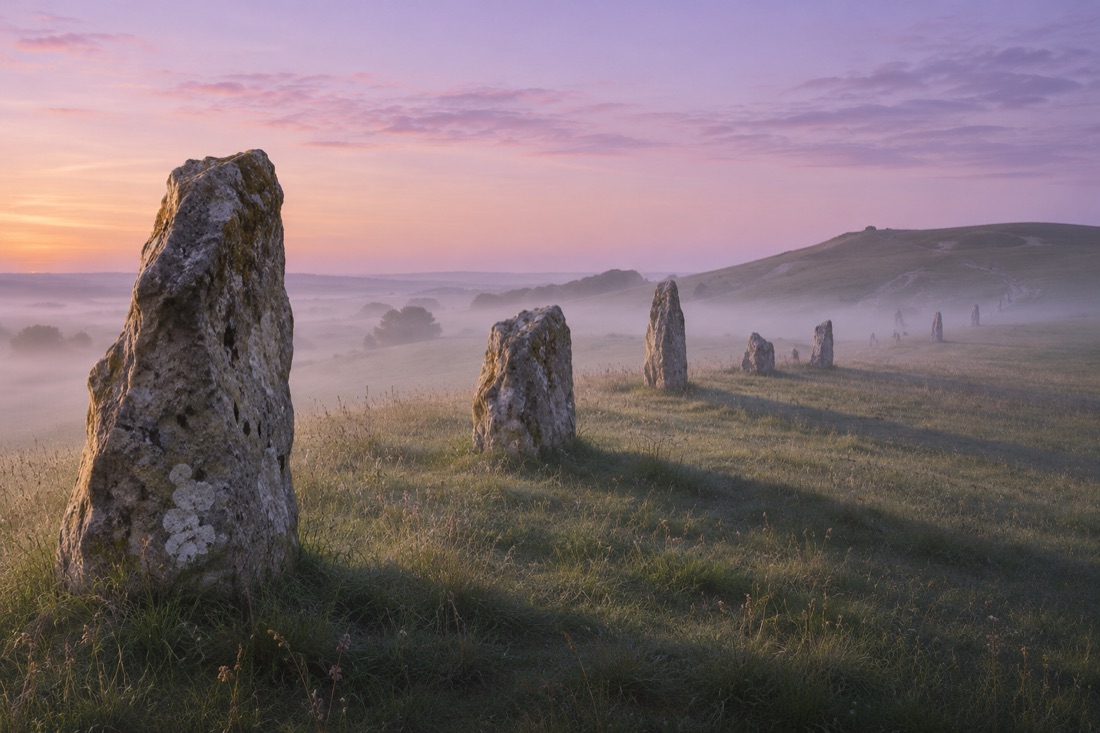
What are ley lines: a walker's observation
The English businessman and amateur archaeologist Alfred Watkins, from Herefordshire, said that in 1921 he saw a pattern on a map: old churches, standing stones, hilltops and crossroads falling on straight lines. He called the lines leys, from a place name element, and in 1925 published his argument in The Old Straight Track.
Watkins proposed something practical. He thought the lines were ancient trackways, marked by prominent points so that travellers could find their way across country. He did not link them with magic or energy.
Ley lines meaning: how the idea changed
After Watkins, other writers began to treat leys as something more. By the middle of the twentieth century some authors connected them with flying saucers, and in 1969 John Michell's book The View Over Atlantis recast them as lines of earth energy and sacred geometry. This is the version that most people now mean by the phrase, and the one behind most ley line maps found online.
The shift matters because it explains why readers meet contradictory claims. The practical track and the energy line are different ideas that share a name.
Are ley lines real: what the evidence says
Archaeologists have pointed out a statistical problem. Britain is densely covered with old churches, mounds, stones and crossroads, so a straight line drawn almost anywhere on a map will pass through several of them. The 1983 study Ley Lines in Question by Tom Williamson and Liz Bellamy made this argument in detail.
No physical instrument has measured an energy along such a line in a way that survives testing. That does not make the idea worthless as culture. It means the honest description is a modern tradition, rather than an ancient one.
Why ley lines still appeal
Leys give a walker a reason to join up places and to look at a landscape as a connected whole. For many people that is the real value, whatever one believes about the lines themselves. If you enjoy the idea, treat it as an invitation to walk, to read maps and to notice old places.
To go further, the Stonehenge and Avebury guide shows two of the sites most often drawn into ley stories, and the timeline puts the idea in the wider history of the field.